

The World Laureates Summit (WLS) concluded on Feb 3 in Dubai, the UAE, with the landmark launch of the OPENSCI initiative, a new framework aimed at reshaping the infrastructure of scientific research.
After two days of discussions on artificial intelligence, life sciences, frontier physics and global governance, the summit's final day shifted focus from how science explains the world to how it will shape the future — and who will lead that transformation.
Young Scientists Take Center Stage
A highlight of the closing program was the Young Scientists Forum, chaired by Adam Riess, laureate of the 2011 Nobel Prize in Physics. Researchers from across disciplines presented work spanning quantum physics, AI, biomedicine, complex systems and engineering.
Speakers emphasized that today's breakthroughs are increasingly interdisciplinary and built on global collaboration, open data and advanced computational tools. The message was clear: the next frontier of science will be defined collectively, by a globally connected generation of researchers.
World Laureates Association (Dubai) Inaugurated
During the summit, the World Laureates Association (Dubai) was unveiled. The ceremony was attended by Omar Sultan Al Olama, UAE Minister of State for Artificial Intelligence, Digital Economy and Remote Work Applications, and Wang Hou, Founder and Executive Director of the World Laureates Association.
The launch signals a deeper institutional presence for the association in the Middle East.
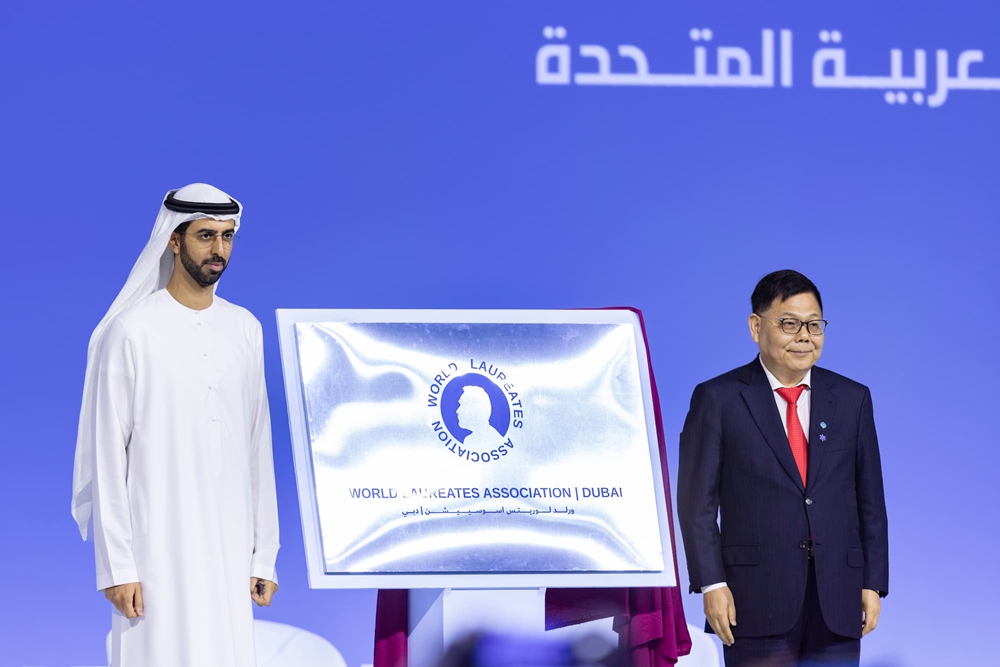
Omar Sultan Al Olama and Wang Hou unveiled the World Laureates Association (Dubai) tablet together.
OPENSCI: Rethinking Research Infrastructure
The summit's defining announcement came from Roger D. Kornberg, Nobel Laureate in Chemistry and President of the World Laureates Association, who introduced the OPENSCI plan.
Kornberg said the current research system struggles to fairly reward scientific contributions and move discoveries efficiently from idea to impact — a gap that has become more visible in the AI era.
OPENSCI, he said, aims to redesign the research value chain using AI and encryption technologies, creating a more open and equitable model for collaboration.
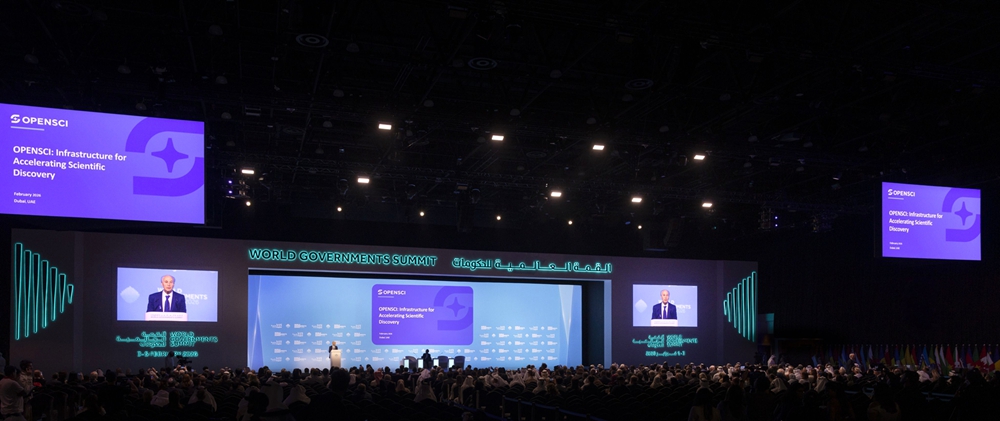
Roger Kornberg introduces the OPENSCI plan at the summit, a more open and equitable model that fairly rewards scientific contributions and moves discoveries efficiently from idea to impact.
A Shared Conclusion
As the summit closed, scientists and policymakers agreed that amid global uncertainty, fundamental science remains a stable foundation for progress.
Organizers said the summit has evolved beyond an assembly for discussion. With the launch of OPENSCI and the expansion of its institutional footprint, WLS is positioning itself as a platform not only for dialogue, but for action.
While the event concluded in Dubai, its organizers expect the OPENSCI initiative to extend well beyond the summit — shaping future models of global scientific cooperation.
In a period of rapid change, science, they argued, remains a guiding light.

 info@wlasci.org
 Unit 1002, 10/F/., Perfect Commercial Building, 20 Austin Avenue, Tsim Sha Tsui, Kowloon, Hong Kong


