

Hard Truths on Energy Crisis from the World Laureates Summit
At the 2026 World Laureates Summit (WLS), a discussion on "carbon neutrality" shattered the usual mild-mannered atmosphere of the forums. While the public continues to cheer for the ubiquity of wind and solar power, three Nobel Prize laureates — Steven Chu, Hartmut Michel, and Andre Geim — unveiled a "reality ledger" regarding the energy transition.
Steven Chu: Blind Spot of Sky-High Costs
The presentation by Steven Chu, 1997 Nobel Laureate in Physics and former US Secretary of Energy, began with a set of figures. He provided a calculation: to get 80% of renewable energy in the United States, we would have to be spending about $125 trillion in just batteries alone.
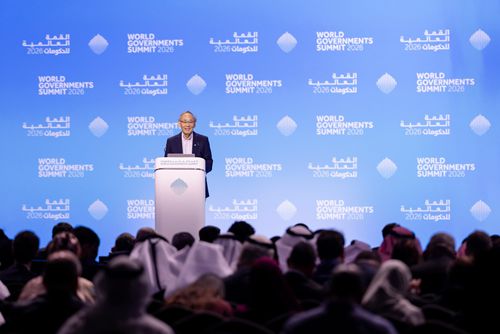
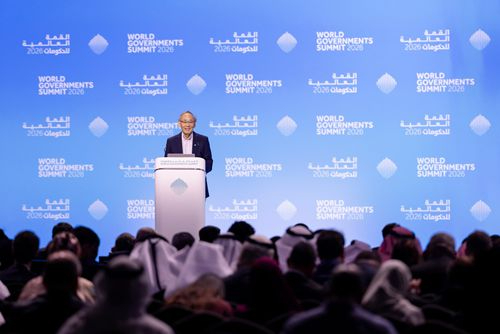
On the third day of the summit, during the WLS-WGS Joint Session, Professor Steven Chu delivers a keynote speech.
This is only the beginning. Chu pointed out that the situation in agriculture is equally dire. Nitrogen in fertilizers not absorbed by plants converts into nitrous oxide, a greenhouse gas with 300 times the warming potential of carbon dioxide and an atmospheric lifetime of 100 years. As the world grows wealthier and fertilizer use increases, this problem worsens, yet no mature technical solution currently exists.
"The full cost of these renewables goes increasingly more as it becomes a larger fraction," Chu stated. He noted that while the Levelized Cost of Energy (LCOE) for solar and wind has plummeted, the real engineering challenges lie in the storage, backup power, and grid upgrades required for high penetration levels.
Michel: A Decade Decrying Biofuel "Nonsense"
Hartmut Michel, the 1988 Nobel Laureate in Chemistry, did not start his critique of biofuels at this summit. As early as 2012, he published an editorial in Angewandte Chemie International Edition titled The Nonsense of Biofuels systematically explaining why biofuels represent an inefficient and unsustainable path.
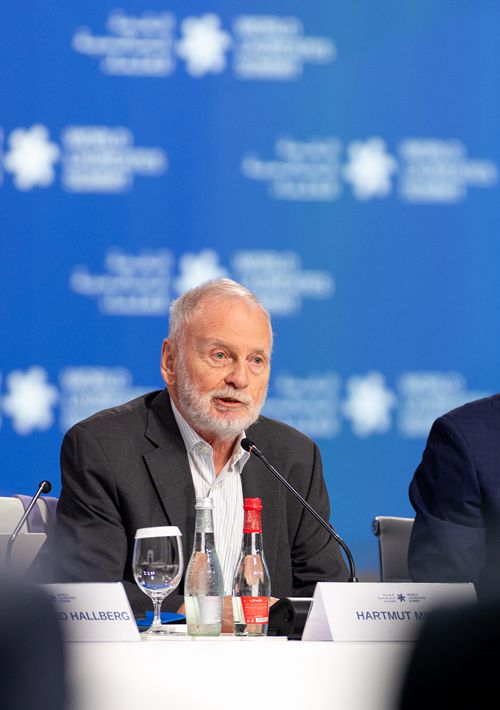
Professor Hartmut Michel delivers a speech at the "New Energy Forum" on the first day of the summit.
In his research, Michel noted that photosynthesis converts solar energy into biomass with less than 6% efficiency, whereas commercial photovoltaic (PV) cells already exceeded 15% efficiency at the time. The energy invested in growing and processing crops for biofuel is only slightly higher than the energy produced. He warned that biofuel production competes directly with food production for arable land, driving up food prices and hurting the poor. Most critically, the efficiency of using biofuels in internal combustion engines is extremely low; storing electricity in batteries to power vehicles is far superior.
Over a decade later, he used German data to further validate this judgment: even if all of Germany's arable land were used for biodiesel, it would only replace about 40% of the country's diesel consumption. Furthermore, biofuel production is not carbon dioxide-neutral, as over 50% of the output value is offset by inputs like fertilizer, cultivation, and transport.
"Do not use agricultural land to produce biofuels," Michel said. His conclusion was clear: using PV cells, electric motors, and battery systems is at least 500 times more efficient at utilizing solar energy than biofuels and internal combustion engines.
Today, reality is catching up with his judgment — according to the International Energy Agency (IEA), the costs of both LFP batteries and solar power have dropped by about 80% over the last decade. A 2026 report from Rystad Energy noted: "Battery storage is no longer just a supporting technology for renewables; it is actively displacing gas-fired generation".
Geim: Is Nuclear Fusion Our Final Gambit?
Andre Geim, the 2010 Nobel Laureate in Physics, was equally outspoken. While acknowledging that renewable energy — wind, solar, and tidal — is undoubtedly vital, he highlighted a fact often overlooked by the public: "They require large upfront investment and it takes decades to compensate for emission spent on renewable installations."
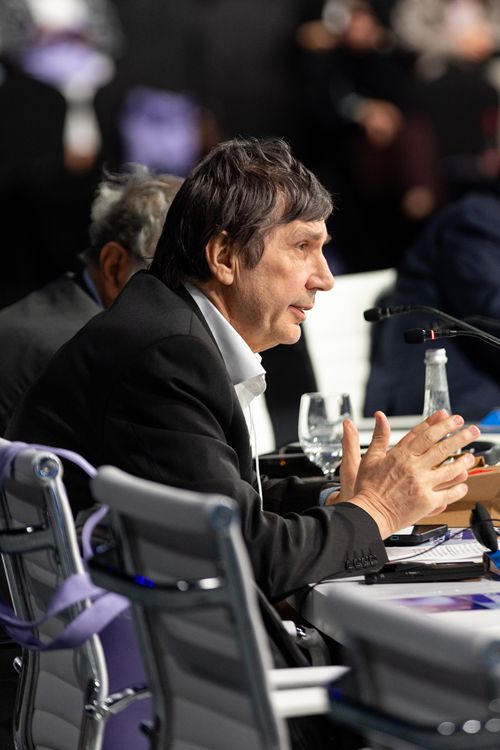
Professor Andre Geim delivers a speech at the "New Energy Forum" on the first day of the WLS.
"People believe that having electric vehicles equates to having clean energy; this is a misconception," Geim said, having previously calculated the costs at the 2022 World Laureates Forum. Manufacturing an EV consumes vast amounts of energy and leaves a significant carbon footprint. For instance, if one million square kilometers of solar panels were installed in Tibet, it would take seven years of power generation just to compensate for the carbon dioxide footprint created during the manufacturing of those panels.
Looking back to 2023, at the 28th UN Climate Change Conference also held in Dubai, nearly 200 parties — including China, the US, the UK, and France — reached the "UAE Consensus". This agreement adhered to the Paris Agreement goal of limiting global warming to 1.5°C and, for the first time, set targets for 2030: tripling renewable energy capacity, slashing methane emissions, and transitioning away from fossil fuels in a just manner to achieve net-zero emissions by 2050 in line with science.
However, in the face of scientific evidence that renewables may not "decarbonize" as smoothly as expected, the challenge of how to properly implement these ambitious goals is surfacing — protecting the Earth may require a more scientifically-driven direction and more refined methodologies.
Geim proposed an even more fundamental perspective: "What produces that carbon dioxide spike? The answer we all know: energy demand on an unprecedented scale. Comfort requires energy — food, housing, transport, heating, clothing, all energy intensives." Global warming is merely a "symptom" of a high-energy-consumption civilization, not the underlying cause. The true contradiction lies between rapidly diminishing resources and rising demand.
Therefore, we must admit, "All current technologies, however essential, are only buying us time, not solving the problem of self; they are stop-gap, not a cure," said Geim.
"The only real gamechanger modern science knows is nuclear fusion," he concluded. Nuclear fusion is relatively clean, virtually inexhaustible, and its scientific principles are fully proven. With it, the recycling of almost all resources would become economically viable. However, utilizing it for sustained energy production still faces monumental technical challenges.
He called for increased funding for nuclear fusion research and a broader investment in basic science, adding, "This is far more meaningful than wasting 5% of GDP on arms races."
Two Faces of Science: From Alarm to Agency
However, Steven Chu's presence at the summit was not defined solely by this "grim ledger".
During his speech on the WLS-WGS Joint Session (the third day of the summit), he traced the trajectory of technological progress: over the past decade, the levelized cost of solar power has plummeted from 45 cents to 3 cents per kWh — and as low as 1.5 cents in the Middle East and Australia. This represents a nearly 30-fold cost reduction in just 10 to 15 years, while wind power costs have decreased fourfold over the same period.
Critically, much like Geim, Chu also pointed out the practical viability of nuclear energy. "The biggest issue is public acceptance, to convince the public that nuclear is far safer, about 1,000 times safer than burning coal, about 100 times safer than burning biomass and wood chips, " he added.
Regarding expenditures, he noted that China has successfully replicated the cost-efficiencies of 1970s US nuclear construction: by maintaining dedicated teams to build reactors sequentially, they have leveraged standardization and cumulative experience to drive down costs.
Based on these observations, Chu proposed a vision of "leapfrog development" for developing nations during an earlier interview with SMG Yicai: "Much like skipping landlines to enter the mobile era, these nations can bypass traditional grid infrastructure through a 'solar + battery' combination." He predicts that within a decade, the costs of solar and storage will drop sufficiently to meet demand without relying on a centralized grid.
Regarding China's ascent in green technology, Chu observed: "China is doing what the US did successfully last century — making long-term investments in basic research." He noted that Chinese enterprises retain a drive to "prove themselves", demonstrating a willingness to invest in the future and lower costs through economies of scale.
This "grim ledger of reality" reveals not pessimism, but a sober rationality: the path to a sustainable future will not be smoothed by mere aspirations. Only by confronting costs, acknowledging limitations, and consistently directing cutting-edge scientific research toward these challenges can truly correct choices be made.
When asked for a message to future generations, Chu's response was simple yet profound: "I hope our generation and the next do everything we can to create a better, safer home for their world."

 info@wlasci.org
 Unit 1002, 10/F/., Perfect Commercial Building, 20 Austin Avenue, Tsim Sha Tsui, Kowloon, Hong Kong


