

Preface and Vision: From a Dual-Core Decarbonization Framework to Energy-System Transformation
I. The Inflection Point of Energy Transition: Front-End Decarbonization
1.1 Declining Renewable-Energy Costs and the Reshaping of the Global Energy Structure
1.2 Technological Drivers of Declining LCOE
1.3 The Role of AI in Further Reducing Renewable-Energy System Costs
II. Carbon Capture: Back-End Decarbonization and a Critical Pathway for Hard-to-Abate Sectors
2.1 The Long-Term Role of CCUS in Net-Zero Pathways
2.2 From Early Engineering Projects to Commercial Expansion
2.3 From Amine Absorption to MOFs and COFs: How Materials Innovation Can Change Capture Efficiency
2.4 Electrochemical Carbon Capture: A Low-Energy Route for Carbon Capture
III. Longer-Term Horizons: Superconductivity, AI-Assisted Materials Discovery, and Energy-System Leapfrogging
3.1 Why Superconducting Technologies Could Change the Energy System
3.2 A New Cycle of High-Temperature Superconductivity Research
3.3 How AI Can Accelerate Superconducting Materials Exploration
3.4 Engineering Pathways and Energy Significance of Superconducting Applications
IV. Global Coordination and Governance: Institutional Conditions for AI-Enabled Energy Transition
4.1 AI and Renewable Energy Are Entering the Core of Policy
4.2 Capital Markets and Industrial Models
4.3 Data, Standards, and Security: The Foundations of AI-Energy Governance
4.4 International Coordination: From Technological Competition to Joint Governance
V. Future Blueprint and Action Roadmap
5.1 Before 2030: From Renewable Capacity Expansion to System Absorption
5.2 2030–2040: Back-End Carbon Removal and Deep Industrial Decarbonization
5.3 After 2040: Superconductivity, Fusion, and New Energy Infrastructure
5.4 Final Action Framework: Five Transitions
Conclusion: The Next Stage of Energy Transition Is System Intelligence
The world is entering a decisive period of energy transition. Climate change, energy security, technological competition, and industrial restructuring are converging at the same historical moment, turning energy from a purely environmental issue into a systemic question that concerns the global economic order, national security, industrial competitiveness, and science and technology governance. The Paris Agreement’s goal of limiting the increase in global average temperature to within 1.5°C above pre-industrial levels has become a central benchmark for evaluating the ambition and effectiveness of climate action. Yet as extreme weather events become more frequent and global greenhouse gas emissions remain high, the urgency of decarbonizing the energy system continues to intensify. Fossil fuels have long supported the expansion of industrial civilization, but they are also the primary source of global carbon emissions. The speed at which the fossil-based energy system transforms will directly determine whether global climate goals remain achievable.
Against this backdrop, renewable energy and carbon capture are jointly forming the “dual core” of energy-system decarbonization. Renewable energy primarily serves the function of front-end decarbonization: replacing fossil fuels with low-carbon energy sources such as solar, wind, hydro, and geothermal power, thereby reducing new emissions at the source. Carbon capture, utilization, and storage, or CCUS, mainly serves the function of back-end carbon management: reducing emissions from high-emission industrial processes, fossil-energy use cases that cannot yet be fully substituted, and accumulated historical emissions. The former determines whether energy production can fundamentally shift toward low-carbon sources, while the latter determines whether hard-to-abate sectors can still enter a credible pathway toward net zero. These two approaches are not substitutes for one another. Together, they form the basic framework for deep decarbonization of the energy system.
The energy transition has entered a new stage not only because climate pressure is increasing, but also because the economics of clean-energy technologies have changed fundamentally. For a long period, renewable energy was regarded as a green option that required policy subsidies and carried relatively high costs. Over the past decade, however, the costs of solar photovoltaics, wind power, and energy storage have continued to fall, transforming renewable energy from an environmental choice into an economic choice. In more and more countries and regions, new solar and onshore wind projects can already produce electricity at lower levelized costs than new fossil-fuel power plants. At the same time, the scaling of energy storage is beginning to mitigate the intermittency and volatility of renewable generation, making high-renewable power systems increasingly feasible in engineering practice rather than merely in theory.
Geopolitical shifts have further amplified the strategic value of energy transition. During the Russia-Ukraine conflict, constrained natural gas supplies and sharp energy-price volatility in Europe exposed the vulnerability of excessive dependence on imported fossil fuels. Energy security is no longer merely a matter of resource reserves; it is a composite capability involving supply-chain resilience, infrastructure redundancy, energy autonomy, and power-system dispatch. For many countries, accelerating renewable-energy deployment is not only necessary for meeting climate commitments, but also a strategic choice for reducing external energy dependence, strengthening industrial security, and improving long-term competitiveness. Renewable energy therefore carries environmental, economic, and security value at the same time. It has moved from the margins of policy into the core of national development strategies.
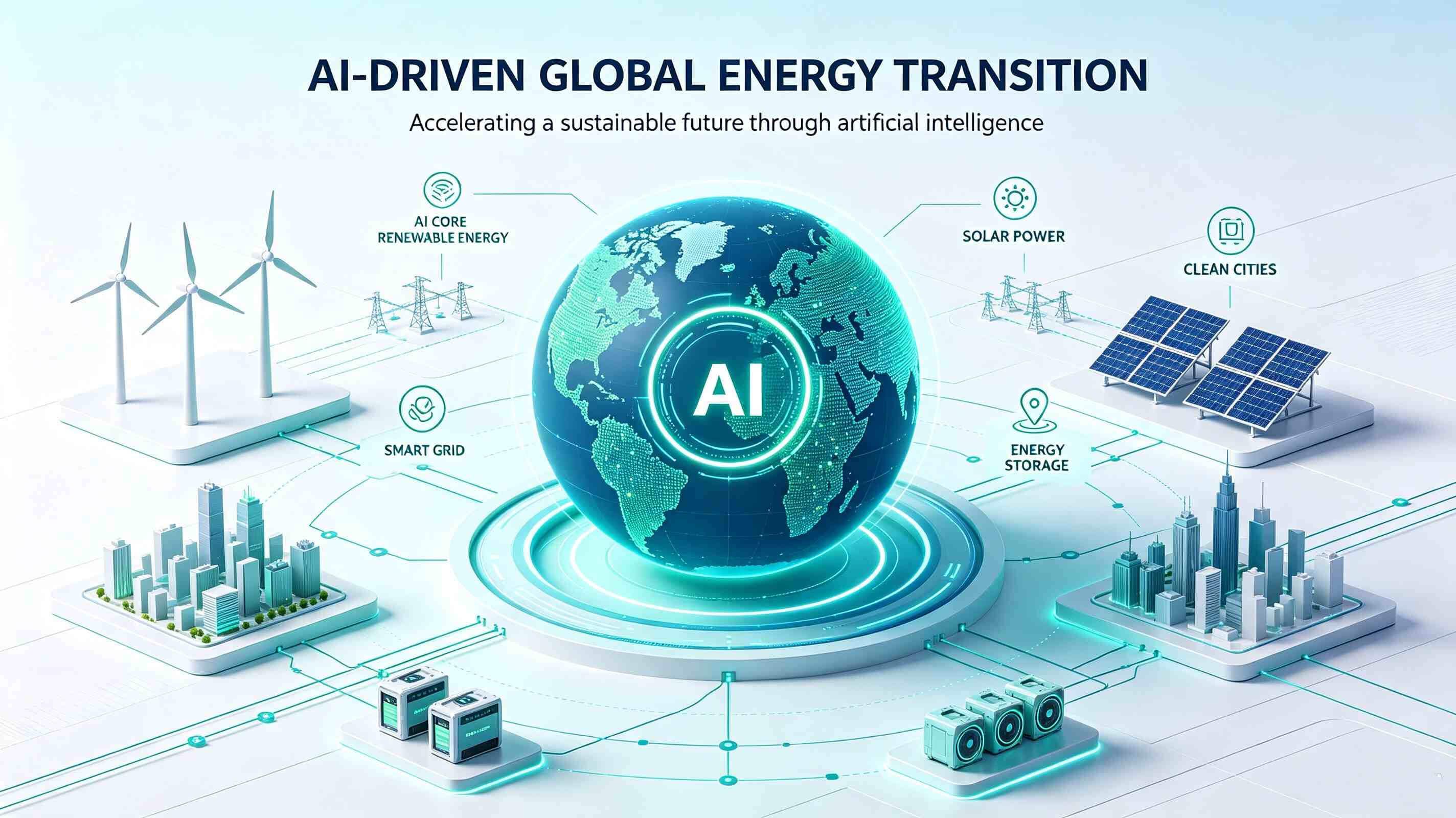
The rapid development of artificial intelligence is providing a new accelerating force for this transition. Earlier waves of energy transition primarily relied on progress in hardware technologies, such as higher solar-cell efficiency, larger wind turbines, cheaper storage batteries, and upgraded grid infrastructure. In the AI era, however, optimization of the energy system depends not only on equipment, but increasingly on data, algorithms, forecasting, dispatch, and system-level coordination. Large models, machine learning, reinforcement learning, digital twins, and automated control technologies are entering multiple layers of the energy system, making it possible to raise the intelligence of energy production, transmission, consumption, storage, and carbon management.
AI’s value in the energy sector is first reflected in forecasting. Renewable energy is naturally variable. Solar generation is affected by weather, cloud cover, temperature, seasonality, and geography, while wind generation is affected by wind speed, wind direction, air pressure, and terrain. Traditional power grids were built around relatively stable centralized generation. High-renewable grids must manage a far more complex, real-time, multi-variable balance between supply and demand. AI can analyze large volumes of meteorological data, historical generation data, equipment-operation data, and electricity-load data in real time, improving the accuracy of generation and load forecasts, reducing reserve-capacity requirements, and increasing the share of renewable energy that can be absorbed by the grid.
AI’s second value lies in dispatch. As the share of renewable energy rises, the relationships among generation, storage, transmission, and demand become more complex. Traditional dispatch often relies on fixed rules and human experience, whereas AI can dynamically optimize grid operation based on real-time data, coordinating storage charging and discharging, price signals, demand response, and cross-regional power transmission. For large solar farms, wind farms, distributed-energy systems, and microgrids, AI can help optimize the balance among cost, stability, carbon emissions, and reliability.
AI’s third value lies in equipment operation and asset management. The economics of renewable-energy projects are determined not only by construction costs, but also by full-lifecycle operation and maintenance costs. Solar modules may suffer from hot spots, shading, aging, microcracks, and inverter failures, while wind turbines may face blade damage, gearbox failures, bearing wear, and yaw-system abnormalities. Through image recognition, sensor monitoring, and predictive-maintenance models, AI can detect equipment anomalies in advance, reduce unplanned downtime, extend asset life, and lower maintenance costs. For large-scale renewable assets, these efficiency gains translate into substantial economic value.
More fundamentally, AI is entering deeper layers of scientific discovery, including energy-materials research, carbon-capture material screening, and superconducting-material exploration. Traditional materials research relies heavily on experimental trial and error, making it long, expensive, and uncertain. Machine-learning models can predict material properties based on existing materials databases and experimental results, helping researchers narrow the candidate space and prioritize materials with high efficiency, high stability, and low-cost potential. Whether in perovskite tandem solar materials, MOF and COF carbon-capture materials, or high-temperature superconducting candidates, AI has the potential to change the speed of materials discovery and engineering validation.
Global energy transition has therefore moved beyond a stage defined by isolated technological breakthroughs. It is entering a new stage driven jointly by cost inflection points, system coordination, and intelligent governance. Renewable energy and carbon capture form the technological foundation of energy decarbonization; storage, grids, and superconducting technologies determine the carrying capacity of future energy systems; and AI, as a systemic variable running through the entire process, is reshaping renewable energy from research and manufacturing to construction, operation, maintenance, and governance. Future energy competition will not be merely a competition for resources or equipment-manufacturing capacity. It will be a comprehensive competition involving clean energy, intelligent systems, data infrastructure, and global coordination.
[CLICK HERE TO DOWNLOAD THE FULL REPORT]



 info@wlasci.org
 Unit 1002, 10/F/., Perfect Commercial Building, 20 Austin Avenue, Tsim Sha Tsui, Kowloon, Hong Kong


